
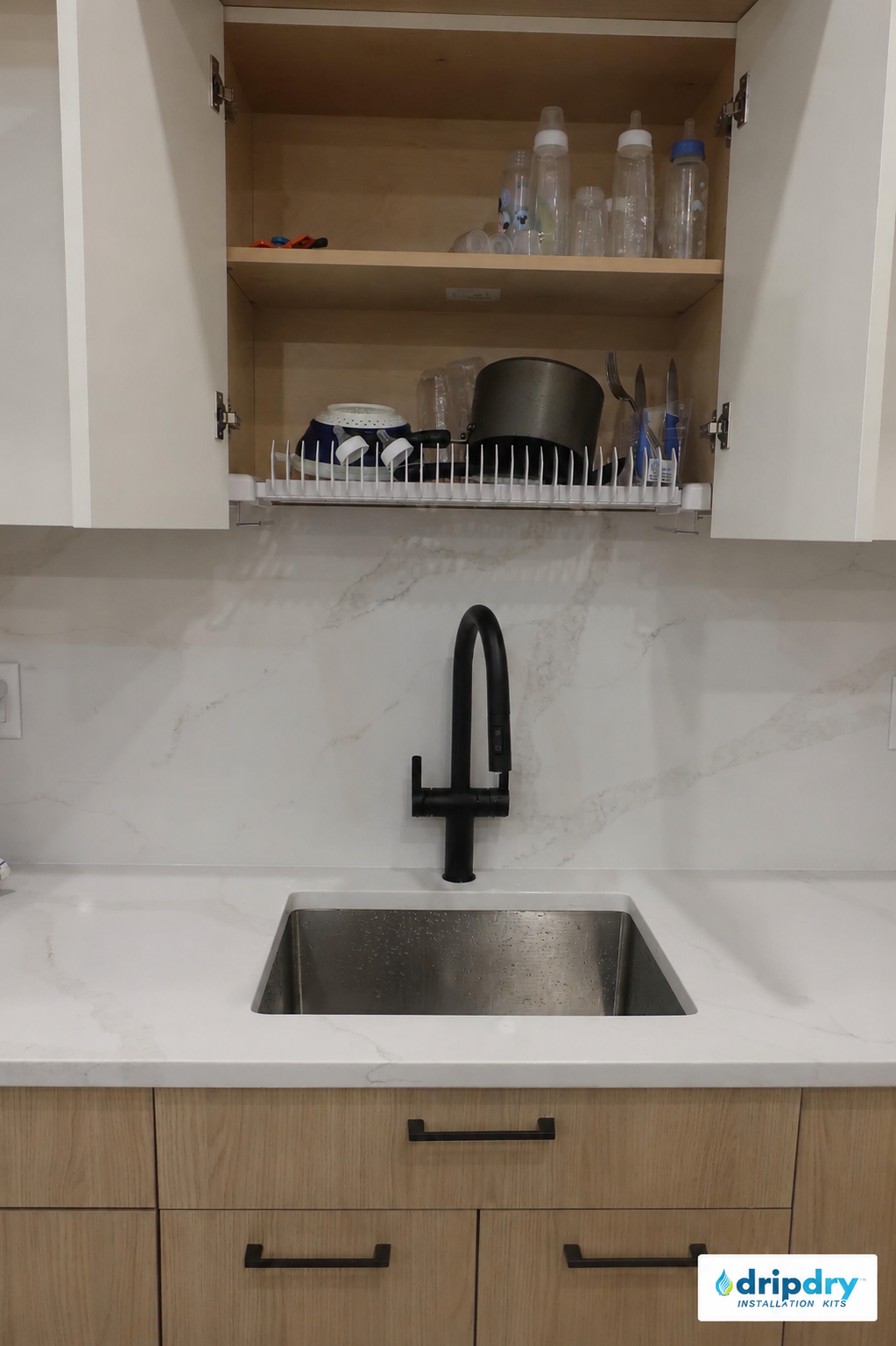
The Drip Dry Kitchen with more space
You have washed the dishes, wiped down the sink and finally cleared the kitchen.
Except for the drying rack.
It is still sitting on the counter, taking up space and making the kitchen look busier than it really is.
Moving that rack into the cabinet above the sink is a simple idea, but it can make a surprisingly big difference. Your dishes can air-dry out of sight, your counter stays available, and the washing-up area feels much more organized.
Once you decide to create a dish drying cabinet, however, you have another decision to make:
Should you choose a static rack or a pull-down rack?
Both do the same basic job, but they feel very different in everyday use.
The Simple Difference
A static dish drying rack stays fixed inside the cabinet. You open the doors, place your dishes on the rack and leave them to dry.
A pull-down dish drying rack moves toward you. You lower the rack, load or unload the dishes, and then return it to the cabinet.
The better option depends on your cabinet height, available space and how comfortable it is for you to reach above the sink.
When a Static Rack Makes Sense
A static rack is often the easiest choice.
There are no lifting arms or pull-down mechanisms taking up space inside the cabinet. That usually leaves more room for plates, glasses and bowls.
It may be the right choice when:
° The cabinet above your sink is easy to reach
° You want a simple system with fewer moving parts
° Your cabinet has limited internal height
° You want to use as much of the cabinet as possible
° You regularly wash several dishes by hand
Static racks can work especially well in smaller kitchens. Because the system stays in one position, it can make efficient use of a compact cabinet.
The main question is whether you can comfortably reach it.
Try standing at your sink and reaching into the empty cabinet. Imagine lifting a wet dinner plate into the rack several times a day. If that movement feels easy, a static rack may be all you need.
If you are stretching, leaning over the sink or lifting your shoulder uncomfortably, a pull-down system may suit you better.
When a Pull-Down Rack Is Worth It
The cabinet above a sink is often installed higher than a normal storage cabinet. That keeps the sink area open, but it can make the cabinet difficult to use.
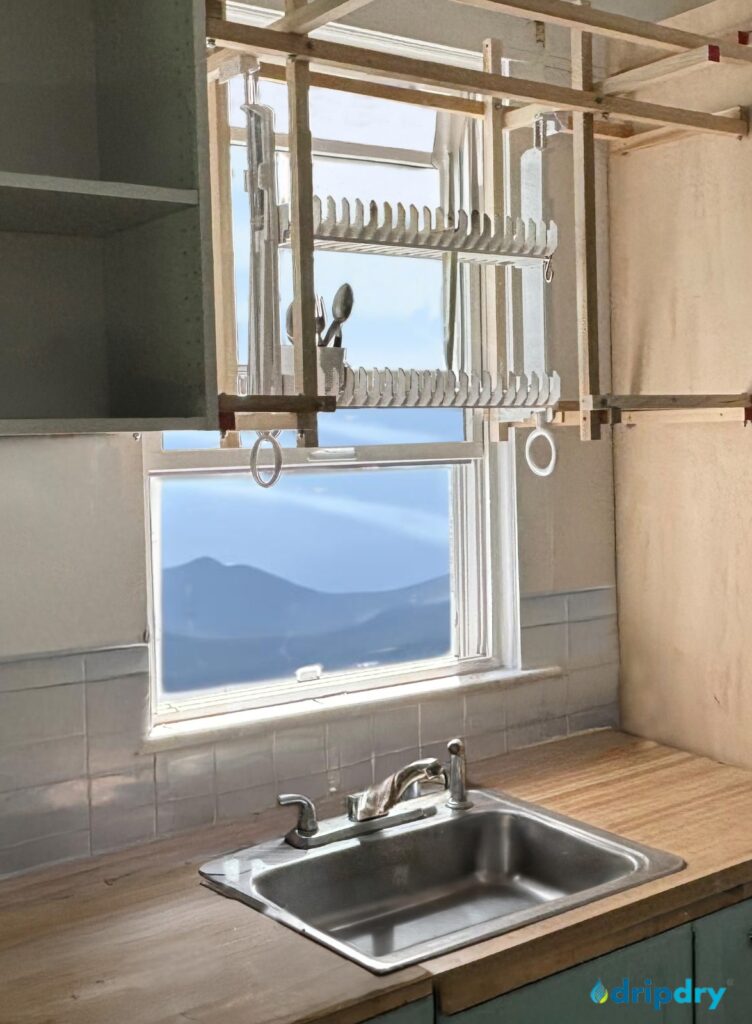
Robert Fu Kitchen No Cabinet Drip Dry Above Sink
A pull-down rack brings the dishes closer to you.
Instead of reaching into the cabinet, you lower the rack to a more comfortable height. Once the dishes are loaded, the rack moves back up and the cabinet doors can be closed.
This can be useful when:
° The wall cabinet is mounted high
° Shorter and taller people share the kitchen
° Reaching above shoulder height is uncomfortable
° You want easier access to the back of the rack
° Accessibility matters more than maximum storage space
A pull-down rack can make the cabinet feel much more practical, but it needs room to move.
The arms, frame and lifting mechanism occupy some of the cabinet’s interior. That may leave less space for dishes than a fixed rack installed in the same cabinet.
Do Not Choose Until You Measure
A rack that looks perfect online may not fit your cabinet.
The width printed on the cabinet door is not always the amount of space available inside. Hinges, framing, side panels and mounting hardware can all reduce the usable area.
Before choosing a system, measure:
° The usable internal width
° The internal height
° The cabinet depth
° The space around the hinges
° The diameter of your largest plates
° The distance between the cabinet and the sink
° The clearance needed for doors to close
For a pull-down rack, also check how much space the mechanism needs while moving.
Measure the cabinet more than once. A few minutes spent checking dimensions can prevent a much more expensive installation problem.
Think About What You Actually Wash
It is easy to focus on the rack itself and forget about the dishes that will go inside it.
Look at what usually ends up beside your sink.
Is it a few coffee cups and breakfast plates? Large dinner plates? Baby bottles? Wine glasses? Food containers? Pots and pans?
A static rack may provide more capacity when you regularly wash a large number of items.
A pull-down rack may be more useful when you wash fewer dishes but want them to be easy to reach.
Also consider whether the cabinet will be used only for drying or whether clean dishes will remain there until needed again.
If the rack becomes part of your everyday storage, accessibility matters even more.
What About Water and Moisture?
Whether you choose static or pull-down, the cabinet must be properly prepared for wet dishes.
This should not be treated like an ordinary wooden cabinet with a metal shelf placed inside it.
The design needs to allow water to drain safely toward the sink while air circulates around the dishes. Cabinet surfaces and exposed edges should also be protected from moisture.
To keep the space fresh:
° Do not place dishes inside with food residue still attached
° Avoid packing plates and glasses too tightly
° Keep drainage areas clear
° Clean the racks regularly
° Wipe any visible moisture from nearby cabinet surfaces
° Check occasionally for trapped water
A well-planned drying cabinet should make kitchen cleanup easier, not create a hidden maintenance problem.
Which Rack Is Easier to Maintain?
A static rack is generally simpler because there are fewer components.
You can remove or clean the rack as recommended without needing to inspect a lifting mechanism.
A pull-down rack also requires routine cleaning, but its moving parts and mounting points should be checked occasionally. The mechanism needs to remain secure and move smoothly while supporting the weight of wet dishes.
Neither system is difficult to maintain when installed correctly. The pull-down option simply has more hardware to care for.
So, Which One Should You Choose?
Choose a static dish drying rack when your cabinet is easy to reach and you want a simple system with generous drying space.
Choose a pull-down dish drying rack when reaching the cabinet is uncomfortable and easier access would make a real difference in your daily routine.
There is no universally better option.
A pull-down rack may look more advanced, but it is unnecessary when the cabinet already sits at a comfortable height. A static rack may offer more room, but that extra capacity is not helpful if reaching it feels awkward every day.
The best choice is the one you will enjoy using after the novelty wears off.
A Quick Test Before You Decide
Stand in front of your sink and open the cabinet.
Reach inside as though you were placing a wet plate onto the rack.
Then repeat the movement several times.
Can you reach the back comfortably? Does your shoulder feel strained? Are you leaning over the sink? Could other members of your household use it easily?
That simple test may tell you more than a product specification sheet.
A dish drying cabinet should remove frustration from your kitchen routine. Whether that means the simplicity of a static rack or the convenience of a pull-down system depends entirely on your space.
Either way, the reward is the same: fewer dishes on the counter and a kitchen that feels calmer, cleaner and easier to use.
Explore The Drip Dry’s static and pull-down dish drying solutions and find the system that fits the way your kitchen actually works.
#TheDripDry #DishDryingCabinet #PullDownDishRack #StaticDishRack #AboveSinkStorage #KitchenOrganization #KitchenStorageIdeas #CleanCountertops #ClutterFreeKitchen #FunctionalKitchen #SmartKitchenDesign #SmallKitchenIdeas #CabinetStorage #ModernKitchen #KitchenRenovation