
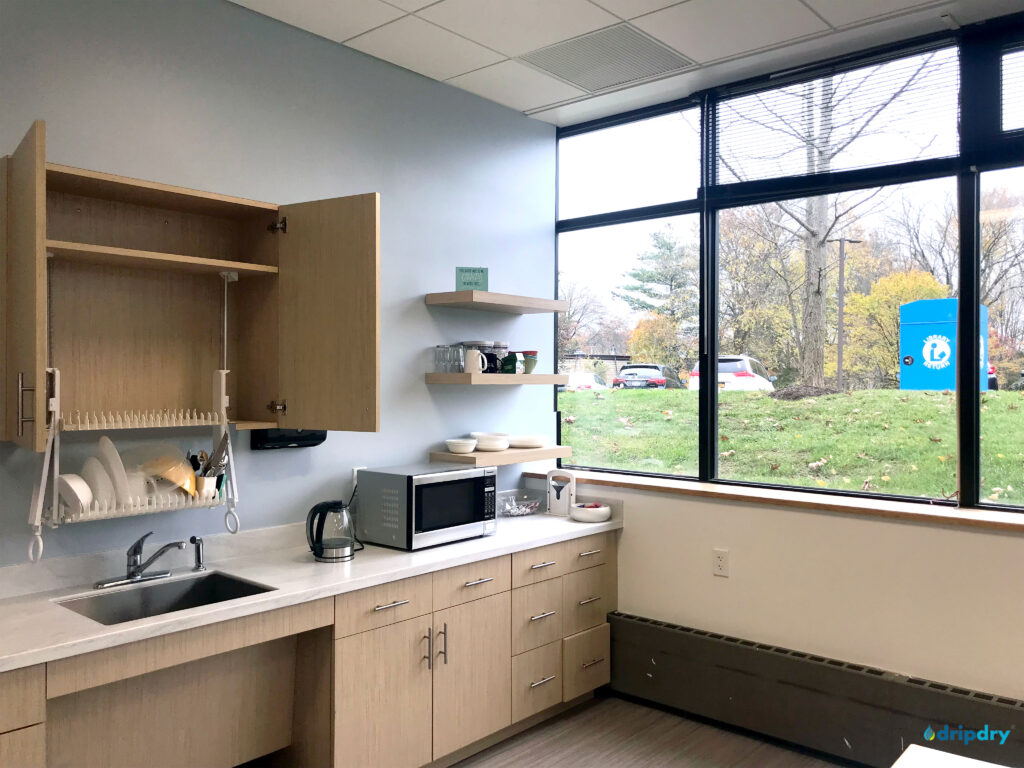
An air-drying wall cabinet may look like a simple storage upgrade, but it can completely change how the area around your kitchen sink functions.
Instead of placing wet plates, glasses and utensils in a rack on the countertop, you place them inside the cabinet above the sink. The dishes air-dry behind closed doors while excess water drains toward the sink.
The result is a cleaner countertop, a more efficient washing area and a kitchen that feels organized even when the dishes have not yet been put away.
But is an air-drying cabinet suitable for every kitchen?
Here is what you should consider before adding one.
What Is an Air-Drying Wall Cabinet?
An air-drying cabinet is a wall cabinet fitted with open drying racks rather than traditional solid shelves.
It is normally installed directly above the sink so that freshly washed dishes can be placed inside immediately. The racks hold plates, bowls, glasses and utensils while allowing air to circulate around them.
Unlike a normal cabinet, the lower section is prepared so that dripping water does not remain trapped inside. Depending on the design, moisture drains toward the sink below.
This creates a simple workflow:
Wash. Place. Air-dry. Store.
For frequently used dishes, there may be no need to move them into another cabinet once they are dry.
Why Install One Above the Sink?
The space above the sink is often underused.
A standard wall cabinet may hold cleaning products, occasional glassware or items that are rarely accessed. Converting it into a drying cabinet gives that space a clear daily purpose.
An above-sink location also makes practical sense because wet dishes remain close to the water source.
You do not need to carry them across the kitchen, place them on towels or leave them sitting in a tray filled with collected water.
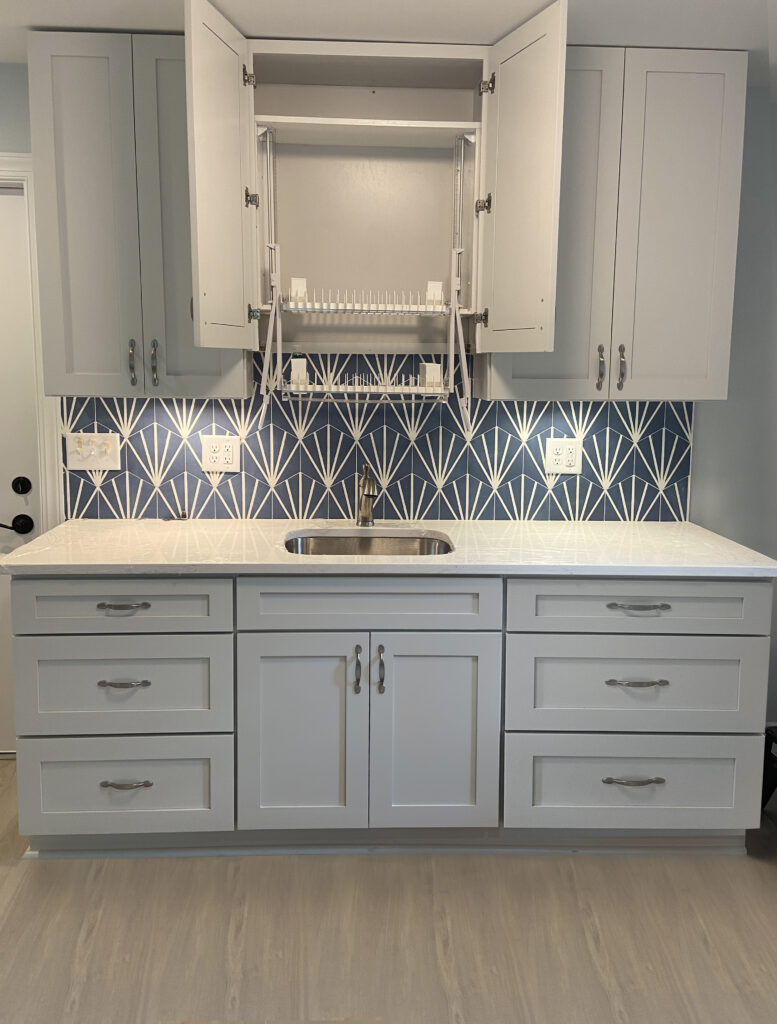
The cabinet can help you:
° Remove the drying rack from the countertop
° Create more food-preparation space
° Keep wet dishes away from quartz, marble and wood surfaces
° Hide visual clutter in open-plan kitchens
° Reduce the number of times each dish must be handled
° Make better use of a compact kitchen
Is Your Kitchen Suitable?
Before choosing a drying rack, inspect the cabinet carefully.
1. Is the cabinet directly above the sink?
The cabinet should be positioned so that water can drain safely toward the sink.
A cabinet located too far to one side may require a different drainage solution and may not provide the same convenient workflow.
2. Is the cabinet wide enough?
Measure the usable internal width—not just the width shown on the cabinet door.
Hinges, side panels, frames and internal fittings can reduce the available space.
Your rack must fit inside without interfering with the doors or hardware.
3. Is there enough height?
The cabinet must provide enough vertical clearance for:
° The drying rack
° Plates and glasses
° A second rack, if required
° Any pull-down mechanism
° Comfortable loading and unloading
Measure from the lowest usable point to the inside top of the cabinet.
4. Is there enough depth?
Check the depth of your largest everyday plates.
They should sit securely without touching the cabinet doors or preventing them from closing.
Do not assume every wall cabinet can accommodate full-size dinner plates.
5. Is the cabinet structurally sound?
Wet dishes add weight.
The cabinet should be firmly attached to the wall and free from swelling, water damage, loose joints or damaged panels.
An old or weakened cabinet may need reinforcement or replacement before installation.
Fixed Rack or Pull-Down Rack?
The best option depends on the cabinet height and who will use it.
Fixed drying rack
A fixed rack remains permanently positioned inside the cabinet.
It is generally suitable when:
° The cabinet is easy to reach
° The user is comfortable lifting dishes upward
° A simple installation is preferred
° Fewer moving parts are desired
Fixed racks can be a practical choice for everyday plates, bowls and glasses.
Pull-down drying rack
A pull-down system allows the rack to be lowered toward the user and returned inside the cabinet after loading.
It may be better when:
° The wall cabinet is positioned higher
° Several people of different heights use the kitchen
° Easier access is important
° Reaching deep inside the cabinet is uncomfortable
A pull-down rack can improve accessibility, but it also requires sufficient internal height and clearance for the mechanism.
How Is Moisture Controlled?
Moisture management is one of the most important parts of the installation.
A drying cabinet should not simply be a normal wooden cabinet with a metal rack placed inside.
The cabinet must be properly prepared so that water does not collect on exposed surfaces.
A suitable setup should allow:
° Water to drain toward the sink
° Air to circulate around the dishes
° Rack components to be removed for cleaning
° Cabinet surfaces to remain protected
° Moisture to escape instead of becoming trapped
Avoid overcrowding the rack. Plates and glasses need space between them so air can circulate effectively.
The rack and surrounding cabinet surfaces should also be cleaned regularly to prevent residue and trapped moisture.
Can It Be Added to an Existing IKEA Kitchen Cabinet?
In many cases, an existing wall cabinet can be adapted, provided its measurements, condition and position are suitable.
For an IKEA kitchen, check the exact cabinet series and internal dimensions before ordering any hardware. Cabinet widths may appear standard, but usable interior space can vary because of hinges, frames and construction details.
You should also confirm:
° Whether the cabinet base needs to be removed or modified
° Whether exposed edges require sealing
° Whether the rack matches the internal width
° Whether the cabinet can support the loaded weight
° Whether the doors will still close properly
° Whether plumbing, lighting or electrical fittings create an obstruction
Some installations may be manageable as a focused kitchen upgrade. Others may require a cabinetmaker or experienced installer.
Do not cut or modify the cabinet until the rack dimensions and preparation requirements have been confirmed.
Is It Worth Adding?
An air-drying wall cabinet is most useful for households that regularly wash items by hand.
It can be especially valuable in:
° Apartments
° Galley kitchens
° Small family kitchens
° Minimalist interiors
° Open-plan homes
° Kitchens with limited countertop space
° Homes where delicate cookware is frequently hand-washed
It does not need to replace the dishwasher.
Instead, it provides a better place for the items that still need to be washed by hand, including knives, glasses, wooden utensils, reusable bottles and non-stick cookware.
A Small Renovation That Improves Everyday Life
An air-drying cabinet is not only about hiding dishes.
It improves the complete washing-up process by placing washing, drying and everyday storage in one compact area.
You regain countertop space.
Water remains closer to the sink.
Frequently used dishes become easier to manage.
And once the cabinet doors are closed, the kitchen looks clean and visually complete.
Before ordering, measure the cabinet carefully, confirm the drainage requirements and decide whether a fixed or pull-down system best suits the people using the kitchen.
A properly planned air-drying wall cabinet can turn an ordinary space above the sink into one of the hardest-working areas in the kitchen.
Ready to remove the countertop drying rack?
Explore The Drip Dry’s fixed and pull-down cabinet drying solutions and review the cabinet preparation requirements before beginning your installation.
#TheDripDry #AirDryingCabinet #DishDryingCabinet #IkeaKitchen #KitchenCabinet #KitchenStorage #CleanCounters #KitchenRenovation #FunctionalKitchen #SmallKitchenIdeas